All your passion projects, in one calm place.
Agents make it easy to start. snyvi helps you finish.
A desktop app where your Claude Code sessions work, one desk for each project, and everything they write is kept as a page you can read.
macOS
$ brew install --cask snymrova/snyvi/snyviNo Homebrew? curl -fsSL https://snyvi.com/install.sh | sh works on a Mac too. Every way to install
Linux
$ curl -fsSL https://snyvi.com/install.sh | shNo root, and every download is checked against its checksum. Read it first. Every way to install
Windows
$ scoop bucket add snyvi https://github.com/snymrova/scoop-snyvi; scoop install snyviNo prompt, no admin. Or the installer. Every way to install
v1.35.0MITLinuxmacOSWindowsup in 11 ms
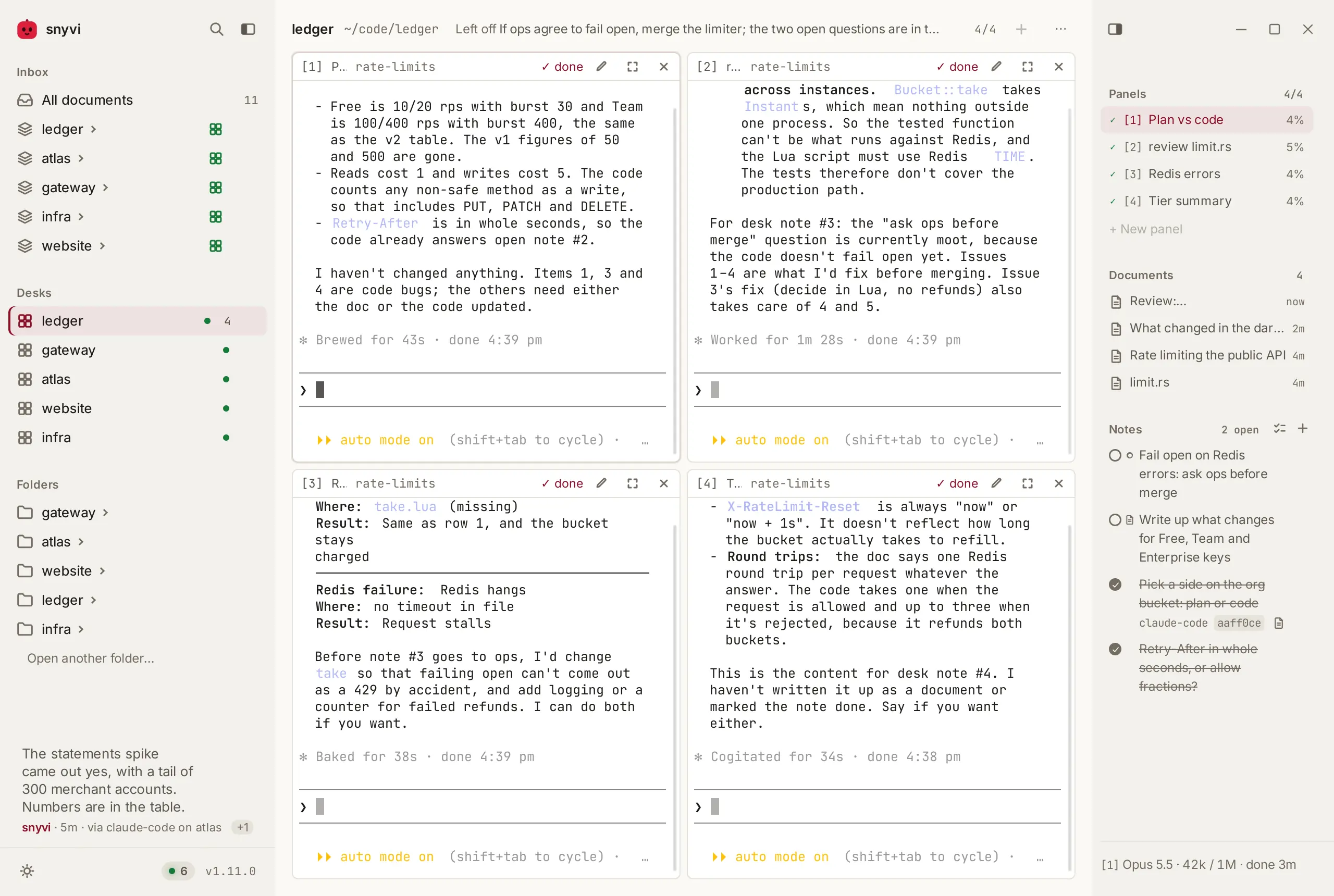
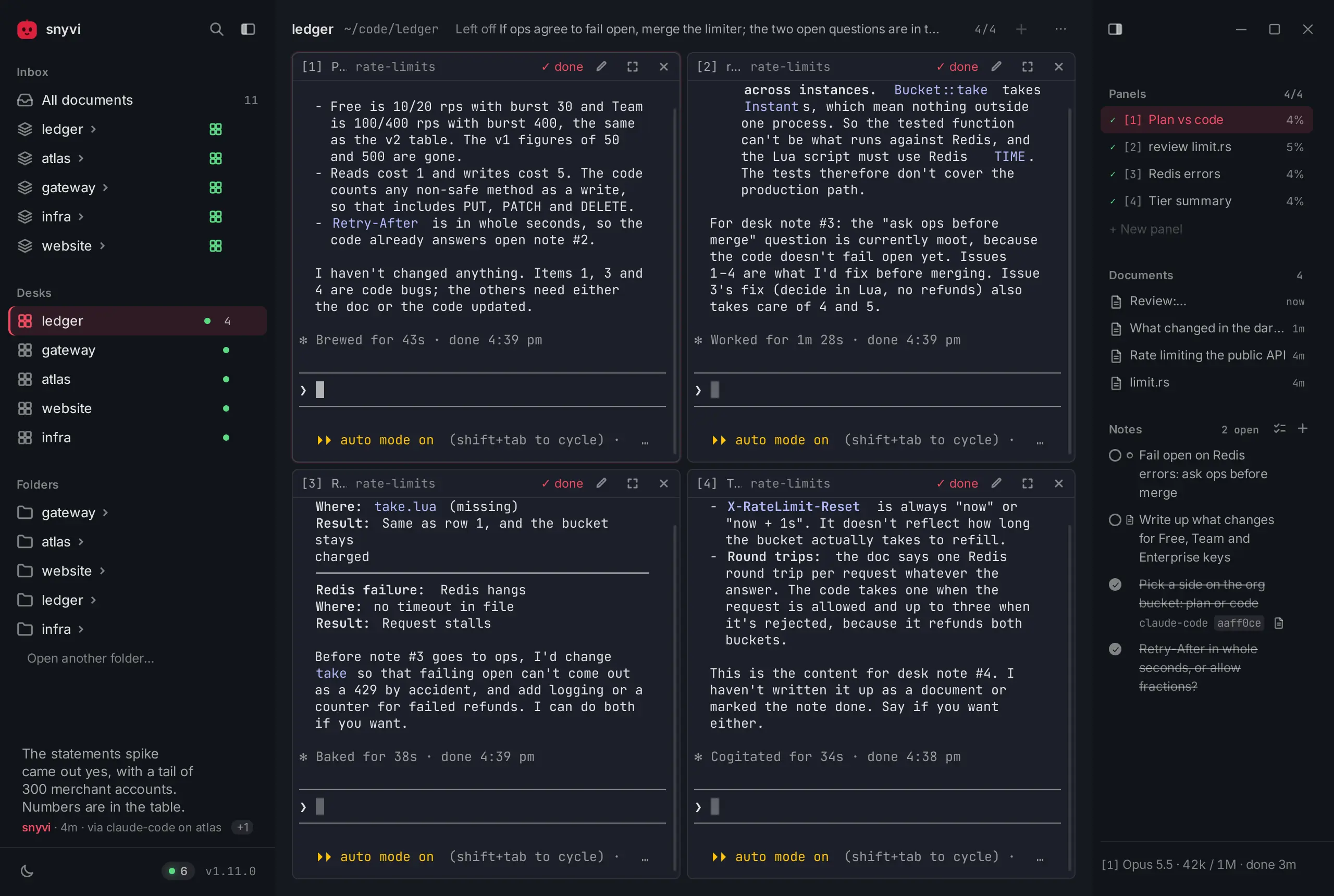
You have more passion projects than hours in the day. With coding agents, you can finally build them all, at the same time.
But the work scatters.
Agents make it easy to start. snyvi helps you finish.
One desk for each project, its agents side by side, and everything they write kept where you can read it. It runs on your machine, with no account and nothing to configure.
One desk for each project
A project's folder with up to four real shells in it: Claude Code, Codex, your tests, a git log. Every agent on the project works in view, and each panel says whether its agent is working, done, or waiting on you.
Nothing scrolls away
Plans and reviews land on the desk that wrote them, marked with the panel they came from, and open as clean pages. They're filed under their project and kept with every earlier version. c shows what changed.
Out of your head
Each desk keeps its own notes, so what's left to do stays with the project. The agents at that desk read them, say how far they've got, and tick one off with the commit it went into. Home shows every desk's list and where each was left.
Only what needs you
What stops a project is rarely the work. It's the one thing waiting on you. When an agent needs a decision, a merge, a key, or a command it was blocked from running, it goes to Your turn, in the desk's corner: a card with the options and the one it recommends, or the command with Run beside it. Answer there, and the answer goes to the panel that asked. Everything else stays out of your way.
Each piece of work is a thread on its panel's row: its notes, its branch, its PR and its checks, from idea to shipped. You can see where every project stands, and what's left before it's done.
Just as you left it
Switch projects and each desk is exactly as you left it. The agents you walked away from keep working.
⌘K searches everything any agent ever sent. So does this page: try it.
Room to focus
When one agent needs all of you, fold the sidebar and the rail away and give its panel the whole window. ⌃⌥Z puts it back in the grid. The others keep working, and their tabs say when one needs you.
A friend's snyvi
Pair once, with three words said over a call, and a document's menu gains Send to… It lands in your friend's sidebar under From you within a second, sealed to their key on the way. A relay holds the ciphertext for a week at most, reads none of it, and keeps it for a snyvi that is asleep. An agent can offer a document to a friend, and you press Send. Nothing else travels. How it works.
Any agent
Claude Code, Codex, Cursor, Gemini, and anything else that speaks MCP. snyvi connects Claude Code from the window on first run. The rest is one line each, and snyvi's Agents page has each one's.
snyvi init-claude --auto   # Claude Code
snyvi init codex           # also cursor, claude-desktop, gemini, windsurf, vscode, zed
Your sidebars
Arrange both sidebars on /sidebars: drag, switch off, reset. Give a desk a small status box an agent keeps up to date, or one a script fills, or one snyvi runs for you on a timer, like the branch you're on and how far ahead it is. Write a widget.
snyvi widget set backups --tone ok "Nightly backup **done**"
snyvi widget new git && snyvi widget check git
How it works
flowchart TB
  A["An agent in a panel<br/>Claude Code, Codex, a shell"] -- "send_document, notes, leave_off<br/>over MCP" --> D["snyvi<br/>one binary on 127.0.0.1"]
  A -. "hooks: working, done, needs you" .-> D
  D --> K["The desk<br/>panels, its documents, its notes"]
  D --> L["The library<br/>every version, searchable"]
  D --> H["Home<br/>where each project was left"]
snyvi runs the panels itself, so an agent in one is a real terminal session on your machine. What the agent writes arrives over MCP, is filed by the folder it came from, and lands on the desk of the panel that sent it. A document sent from anywhere else lands in the inbox, under its project.
Private, and fast
- Listens on
- 127.0.0.1, and nowhere else
- Account
- none
- Telemetry
- none
- Cold start
- 11 ms to first health
- The binary
- one, static, 17.4 MB
- Updates
- signed, and checked before they're applied
Every number here is one a bench reads on every push, with a budget it's held to. Measured so far. What does leave your machine, and when, is on one page.
Questions
Is it free?
Yes, and open source under the MIT licence. There is no paid tier.
Does anything leave my machine?
Nothing of yours, unless you send it. snyvi listens only on 127.0.0.1, has no account and sends no telemetry. It reaches out for three things, each only when you'd expect it: the update check every six hours or so (snyvi update off stops it), a document you press Send on for a paired friend, sealed to their key, and the tour's clips if you open it. The whole list.
Do I have to work in desks?
No. Any agent anywhere can send snyvi what it writes, and it lands in the inbox under its project. Desks are for when you want the agents in view.
Can each desk use a different Claude account?
Yes. Sign in to another account from a desk's keys sheet, and that desk's panels start as that account. Right-click a panel to run it as another, back into the same conversation. When a panel hits its usage limit, it offers Continue as your other account, right there, and picks the conversation up where it stopped. Your settings, hooks and history stay shared. How.
Windows says it "protected your PC".
The Windows installer isn't signed yet, so SmartScreen asks once: More info, then Run anyway. Scoop installs without the prompt, and winget will once Microsoft's review is through. Signing is on its way; the code signing policy says what will be signed, and how.
Can I use the faces?
The one in the corner is snyvi, and the app icon is the same drawing. It has six faces and speaks only when spoken to. They're MIT like the rest, so use them for anything about snyvi.

Install snyvi
Free, MIT, and on GitHub. Your first five minutes:
- A desk for a project. It asks what you're working on. That folder becomes a desk, with Claude Code ready in its first panel.
- Claude's first page. Ask for a plan. It lands on the desk as a page you can read, not in the scrollback.
- Your answer to Claude. Read it, and answer in the panel beside it. That's the loop.
- Back another day. The desk is just as you left it, with the plan, the notes and where it stopped.
macOS
$ brew install --cask snymrova/snyvi/snyviNo Homebrew? curl -fsSL https://snyvi.com/install.sh | sh works on a Mac too. Every way to install
Linux
$ curl -fsSL https://snyvi.com/install.sh | shNo root, and every download is checked against its checksum. Read it first. Every way to install
Windows
$ scoop bucket add snyvi https://github.com/snymrova/scoop-snyvi; scoop install snyviNo prompt, no admin. Or the installer. Every way to install